Mary Heffernan
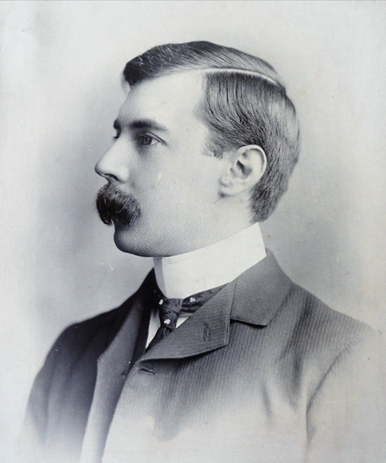
Outside of literary settings, accounts of the introduction of psychoanalysis have been neglected in the historiography of Ireland. It is widely accepted that the all-pervading dominance of conflicting political and religious identities left little capacity for alternative forms of thinking on the self, particularly prior to the revolutionary period. Psychoanalyst Ernest Jones bemoaned a parochialism among physicians in Britain who resisted the latest continental developments and could ‘not even read German’.[1] While many asylum doctors were preoccupied with the mental health consequences of tea-drinking and alcoholism, 1913 saw one Belfast alienist, steeped in traditions of degeneration and moral management, become a charter member of the London Psycho-Analytical Society and a doyen of popular mental health in newspapers from Melbourne to New York.[2]
The numbers of those being admitted to ‘lunatic asylums’ in Ireland climbed relentlessly in the post-Famine era. Historians of Irish asylums explain this by pointing to poverty, social stigma and changes in how families used institutions.[3] By the end of the nineteenth century, pessimism prevailed. Andrew Scull describes the despair that engulfed global psychiatry as therapeutics amounted to little more than the warehousing of ‘lunatics and imbeciles’ in ever larger facilities and asylum doctors bemoaned the relentless nature of accumulation and degeneration.[4] But there was one exception to this litany of misery. At the close of the nineteenth century German psychiatry found itself well-funded and evolving with the establishment of clinical research centres installed alongside their own vast asylums. Emil Kraepelin (1856-1926), Alois Alzheimer (1864-1915), and others were in the vanguard of new thinking on the nosology and pathogenesis of mental illness.[5] Edwardian alienists were convinced that the squalor and dirt associated with industrialised city living had contributed to the inexorable rise in rates of insanity.[6] They believed mental illness was inherited and the cramped conditions within which the ‘feeble minded’ lived was a contributary factor in its spread. The German Villa Colony saw the construction of asylums as idealised ‘villages’ in spacious rural locations, removed from urban living. Quaint individual dwellings gave the impression of an ‘open door’ policy for patients as opposed to the restraint employed in vast institutional asylums of the past. Comprising extensive grounds, a farm, chapel, laundry, and laboratory, the asylum could become self-sufficient, a ‘world unto itself’.[7] The Colony removed the mentally ill from interaction with urban society, provided the open-air living conditions believed to be essential to recovery and thus the transmission of insanity was limited. It was lauded as both hygienic and fiscally attractive. In 1893 the director of the Alt-Scherbitz asylum near Leipzig, Dr Albrecht Paetz, published a detailed account of its management and construction which led to the Villa model being the most favoured asylum system throughout Europe.[8]
In Belfast, William Graham, the brother of a Presbyterian clergyman and two doctors, had initially received a conventional medical training. He demonstrated an early interest in anthropology and explored connections between the spiritual and the scientific. Writing on The Psychology of Christian Science and The Science of a Future Life, herevealed the tensions between the spirituality of his devout presbyterian background and his devotion to all things scientific.[9] But things were changing for medical students in Ulster at the close of the 1900s. A sense of stagnation in Belfast’s medical school and a growing separation from institutions in Dublin led many students to embark on a post-graduate medical ‘grand tour’ of Europe.[10] William was able to study on the Continent and his nephew Robert (1876-1907), a gifted neurologist, travelled extensively in Munich and Freiburg, the birthplace of another young neurologist, Sigmund Freud.[11] Both were able to read German. The Grahams were deeply influenced by developments in European psychiatry and their power and influence ensured that their asylum at Purdysburn employed no fewer than four of the immediate Graham family on the medical staff. Having had remarkable success at bringing improvements to the Armagh asylum, on promotion to Chief Resident Medical Superintendent at Belfast, William pushed successfully for a ‘Villa Colony’ following the new German style, in rural Purdysburn,.[12] It was the only such asylum constructed in Ireland and one of the first in the United Kingdom. A research laboratory, which Robert installed on-site during his uncle’s tenure, followed the scientific model of the German institutes they had both visited. By 1901 the Inspector of asylums in Ireland, Sir George Plunkett O’Farrell, was praising the excellence of the general management, ability and zeal of officials at the Colony.[13]

William was prolific in presenting at conferences and producing lively asylum reports, a contrast to the usual gloomy reporting of housekeeping and statistics, he showcased his own lively views on the causes of insanity and its treatment. Local newspapers began to pick up his commentary and gradually his reports became syndicated in newspapers throughout Britain and Ireland.[14] When his friend and colleague, William Calwell, published his Textbook of Medical Treatment in 1910, Graham contributed the chapter on insanity. It was here thathe revealed an interest in the subconscious self championed by Pierre Janet and referred to a ‘psycho-therapeutic conversation between patient and physician’.[15] An admirer of another teutonophile, Karl Pearson, William’s fascination with anthropology, heredity and degeneration broadly aligned with the biological disease-based theories of his contemporaries.[16] However, a gradual change in his thinking on neurosis and its treatment can be traced from the opening decade of the twentieth century onwards.
A year after Calwell’s book was published, William Graham presented his paper, Psychotherapy in Mental Disorders, to the annual conference of the Medico-Psychological Society in Dublin. He offered his assessment of various psychotherapeutic methods, including Freudian psychoanalysis. Neatly sidestepping any problematic sexual aspects, he created a distinction between Freudian ‘psychological doctrine… and the therapeutic method of psycho-analysis’.[17] He presented two cases of female subjects, in one a hypnoidal state had been induced to retrieve a lost memory and in the other a dream analysis identified mental conflicts arising from ‘the suppression of a sexual desire’.[18] William outlined the most straightforward cathartic method and some attempts at hypnosis. His knowledge was theoretical rather than technical but, at this phase in the development of psychoanalysis, methodology was in its infancy and training certainly not available in Ireland. In the discussion that followed William became increasingly frustrated with colleagues who failed to be enthused by these new discoveries. A warmer welcome for his interests was found in London when he became a charter member of the Psycho-Analytical(sic) Society, founded in 1913 by Ernest Jones.[19] From that point onwards his reports routinely referred to unconscious processes, he revered ‘the glory of Freud and his disciples’, and confirmed his view that so much was owed to the Germans.[20] For William the psychoanalytic method laid bare the emotional wound to the mind and thus uniquely held the promise of healing.[21]
In 1914 William took an extended leave of absence from the asylum to travel to the first annual meeting of the British Association for the Advancement of Science held in Australia. The imminent outbreak of war in Europe has left the significance of three hundred British representatives travelling to an ‘Olympics of science’, largely forgotten.[22] William’s wife Stella, descended from the Irish ascendancy but born in Australia, was the granddaughter of Charles Kemp. Kemp was the proprietor of the Sydney Morning Herald and Australian syndication brought William’s views on insanity to an even wider audience.[23] Interviewed for a local paper in Tasmania during his trip he described himself as ‘an anthropologist from Belfast’, a return to his earliest passion.[24] The anthropology section was also attended by W.H.R. Rivers.[25] Like Graham, Rivers was discomfited by the sexual aetiology of Freudian theory, yet his work on shell shock was transformative for psychoanalysis in Britain.[26]
The war cut short their adventures and on his return, William was immediately commissioned into the RAMC and established the Belfast War Hospital. He continued to have articles based on his asylum reports widely published and in 1916 the New York Times described him as ‘one of the leading authorities in Ireland on mental troubles’.[27] Struggling with the notion of a German enemy, William’s wartime optimism lay in his conviction that a social correction was in motion globally, a ‘new type of civilisation implying greater happiness and more mental equilibrium…’.[28] His positivism in the face of the horrifying death toll was dismaying but undoubtedly a morale boost to his readers.[29] Graham’s vision of post-war civilisation also turned to the advancement of women. ‘The war has enfranchised women’ he declared in 1916.[30] His ‘feminism’ was another echo of Pearsonian dogma. While it encouraged the advancement of women, it sought to control any progress which might lead to an undermining of social stability.[31] It certainly did not extend to recruiting women doctors to the asylum.

William Graham died prematurely on 5th November 1917. He had fallen in the Purdysburn grounds and days later developed a fatal pulmonary embolism.[32] His premature death at 56 was deeply mourned and the Belfast Telegraph, rather extravagantly, announced the death of ‘one of the greatest living authorities on mental disease…’.[33] He was a nineteenth-century man, striving to embrace twentieth-century modernity, in a country too locked into centuries-old political and religious divisions to take up psychoanalytic ideas with widespread enthusiasm. Had he lived, his work on shell shock may well have followed Rivers at Craiglockhart.
A natural dissenter dedicated to his profession; Graham was not overtly political or religiously proselytizing in his lifetime. Described in one Belfast obituary as a ‘staunch’ Unionist, he had possibly become identified locally with his brother’s widely known anti-home rule stance and vigorous Presbyterianism.[34] Instead, William’s determination to combine the scientific with the spiritual led him to psychoanalysis as a secular, non-biological, concept of the self. His status certainly allowed him to operate his own fiefdom at the asylum, where the latest medical and therapeutic developments were trialled. With these trials, the Graham family brought a distinctive European influence to bear on psychiatry in Belfast. However, as Ireland moved ever closer to rebellion and partition, that favouritism in appointments did not go unnoticed. A scathing attack in the Freeman’s Journal cited William Graham’s appointment to Superintendent as proof of sectarianism within the asylum service.[35]
While perhaps a prophet without honour in his own country, William’s relentless intellectual curiosity placed an Irishman at the table of the first psychoanalytical society in London. He offered the possibility of alternatives to the entrenched beliefs of his Irish colleagues. While there was limited acceptance of these ideas initially, William Graham opened wide the door to modernist concepts of the mind. Cautiously and in time others in Ireland would follow him through it.
Further Reading
Peter Gay (Ed.), The Freud Reader, (London, W. W. Norton & Co., 1989).
Leslie Topp, Freedom and the Cage, Modern Architecture and Psychiatry in Central Europe, 1890–1914, (Pennsylvania, Pennsylvania State University Press, 2017).
Lynette Russel (Ed.), A Trip to the Dominions, The Scientific Event that Changed Australia, (Victoria, Australia, Monash University Publishing, 2021)
Andrew Scull, Madness in Civilisation, A Cultural History of Insanity From the Bible to Freud, from the Madhouse to Modern Medicine, (London, Thames & Hudson, 2015).
Gillian Allmond, Village and Colony Asylums in Britain, Ireland and Germany, 1880-1914: Environmental approaches to patient treatment in Edwardian institutions for the insane, (Oxford, BAR Publishing, 2021).
*Sigmund Freud, (1856-1939), considered to be the founder of the psychoanalytic method and he developed a model of the mind based on unconscious processes. A psychological rather than a biological or social model, Freud considered psychoanalysis to be a science, but this is widely contested. Born in Freiburg, Moravia, when it was part of the Austrian Empire, he died in Hampstead, North London.
[1] Philip Kuhn, Psychoanalysis in Britain 1893-1913, Histories and Historiography. (Maryland & London: Lexington Books, 2017), p. 10.
[2] R. Andrew Paskauskas. (Ed.) The Complete Correspondence Sigmund Freud and Ernest Jones 1908-1938, (Massachusetts: Belknap Harvard University Press, 1993), p.233.
[3] Mark Finnane, ‘Asylums Families and the State’, History Workshop, Autumn: 20 (1985), pp. 134-148, p.141.
David Wright, ‘Getting Out of the Asylum: Understanding the Confinement of the Insane in the Nineteenth Century’, Social History of Medicine, 10:1 (1997), pp. 137-155, p.150.
Brendan Kelly, Hearing Voices: The History of Psychiatry in Ireland (Kildare, Ireland: Irish Academic Press, 2016).
[4] Andrew Scull, Madness in Civilisation, A cultural history of insanity from the Bible to Freud, from the Madhouse to modern medicine (London: Thames and Hudson, 2015), p.244.
[5] Ibid. P.262.
[6] Gillian Allmond, ‘Levelling Up the Lower Deeps: Rural and Suburban Spaces at an Edwardian Asylum’, in Georgina Laragy, Olwen Purdue and Jonathan Jeffrey Wright (eds), Urban Spaces in Nineteenth-Century Ireland (Liverpool: Liverpool University Press, 2018), p. 125-143.
[7] Leslie Topp, Freedom and the Cage, Modern Architecture and Psychiatry in Central Europe 1890-1914 (Pennsylvania: Pennsylvania State University Press, 2017), p.1958.
[8] Ibid. P.1328
[9] ‘Irish Division’, Journal of Mental Science, 53:220 (1907), pp. 223-225, p. 224.
William Graham, ‘Science and a Future Life’, Journal of Mental Science, 51:212 (1905).
[10] Peter Froggatt, ‘The distinctiveness of Belfast medicine and its medical school’, The Ulster Medical Journal, 54:2 (1985), pp. 89–108. P.100.
[11] Peter Gay, (ed.), The Freud Reader (London: Vintage Books, 1995), p. 772.
[12] ‘At the Armagh Asylum’, The Armagh Standard (18 January 1895), p. 3.
[13] ‘Belfast Asylum’, The Irish News and Belfast Morning News (1 December 1901), p.4.
[14] ‘The Mental Relief of Gardening’, Yorkshire Evening Post (24 July 1909)., p. 4.
‘Insanity and it’s Prevention: Report by Dr Graham, Belfast: The Need for Healthy Occupation’, Lisburn Standard(24 July 1909), p. 4.
[15] William Graham, ‘Insanity’, in William Calwell (ed.), A Textbook of Medical Treatment(London: Edward Arnold, 1910), pp. 269-303.
[16] J.G. Howells, ‘The Establishment of the Royal College of Psychiatrists’, in German E. Berrios and Hugh Freeman (Eds.), 150 Years of British Psychiatry 1841-1991 (London: Gaskell), pp. 117-34.
[17] William Graham, ‘Psychotherapy in Mental Disorders’, Journal of Mental Science, 57:239 (1911), pp. 617-628, p.621.
[18] Ibid. p.621.
[19] R. Andrew Paskauskas. (Ed.) The Complete Correspondence Sigmund Freud and Ernest Jones 1908-1938, (Massachusetts: Belknap Harvard University Press, 1993), p. 233.
Karl Abraham, ‘Korrespondenzblatt der Internationalen Psychoanalytischen Vereinigung’, Internationale Zeitschrift für Psychonalyse, 2:4 (1914), pp. 405-417, p.411.
[20] ‘83rd Annual Report of BDLA, Year Ending 31st December 1912’, PRONI, 1912, Ref: HOS/28/1/5/7, p. xiii.
[21] Ibid.
[22] David Fisher, producer, ‘The 1914 visit that changed Australia’, The Science Show with Robyn Williams (Radio programme), ABC Online (10 July 2021), last accessed 1 April 2022 at https://www.abc.net.au/radionational/programs/scienceshow/the-1914-visit-that-changed-australia/13439094.
‘The Big Australian Science Picnic of 1914’, The Guardian, (3 September 2014), last accessed 1 April 2022 at https://www.theguardian.com/science/the-h-word/2014/sep/03/big-australian-science-picnic-1914-history.
[23] ‘War and Industry, Big Reduction in Lunatics’, The Mail, Adelaide South Australia (6 January 1917), p.3.
[24] ‘About People’, Launceston Examiner (5 August 1914), p. 5.
[25] Dr William Halse Rivers(1864–1922) was a British anthropologist, neurologist, ethnologist and psychiatrist. He is best known for his pioneering treatment of soldiers of the Great War who were suffering from Shell-Shock at Craiglockhart War Hospital, Edinburgh. After reading Feud he began to use the ‘talking cure’ in his treatment and his most famous patient was the war post, Siegfried Sassoon. Sassoon became one of psychoanalysis most well-known early patients.
[26] Ben Shepherd, A War of Nerves: Soldiers and Psychiatrists 1914-1994, (London: Pimlico, 2002), p.87.
[27] ‘War and Insanity’, New York Times Magazine (1 November 1916), p.276. Last accessed 20 April 2022 at https://www.nytimes.com/1916/08/23/archives/reports-war-has-lessened-insanity-dr-graham-an-irish-alienist-finds.html .
[28] ‘87th Annual Report BDLA’, PRONI, 1916, Ref. No. HOS/28/1/5/8, p. viii.
[29] ‘How Wonderful Life Really Is’, The Kalgoorlie Miner, Western Australia (9 November 1916), p.8.
[30] ‘87th Annual Report BDLA’, PRONI, 1916, Ref. No. HOS/28/1/5/8, p. xi.
[31] Donald MacKenzie, ‘Karl Pearson and the Professional Middle Classes’, Annals of Science, 36 (1979), pp. 125-143, p.135.
[32] ‘Register of Births, Marriage and Deaths’, Ballylesson, Lisburn, Co. Down, Northern Ireland.
[33] ‘Death of Dr William Graham, Expert on Mental Disease: Brilliant Professional Career’, The Belfast Telegraph (10 November 1917)., p. 4.
[34] ‘Death of Dr William Graham, Medical Superintendent of Belfast Asylum, Specialist in Mental Diseases’, The Belfast Newsletter (7 November 1917)., p.8.
[35] ‘The Asylum Medical Service’, The Freeman’s Journal (18 August 1897), p.4.
 HSTM Network Ireland